

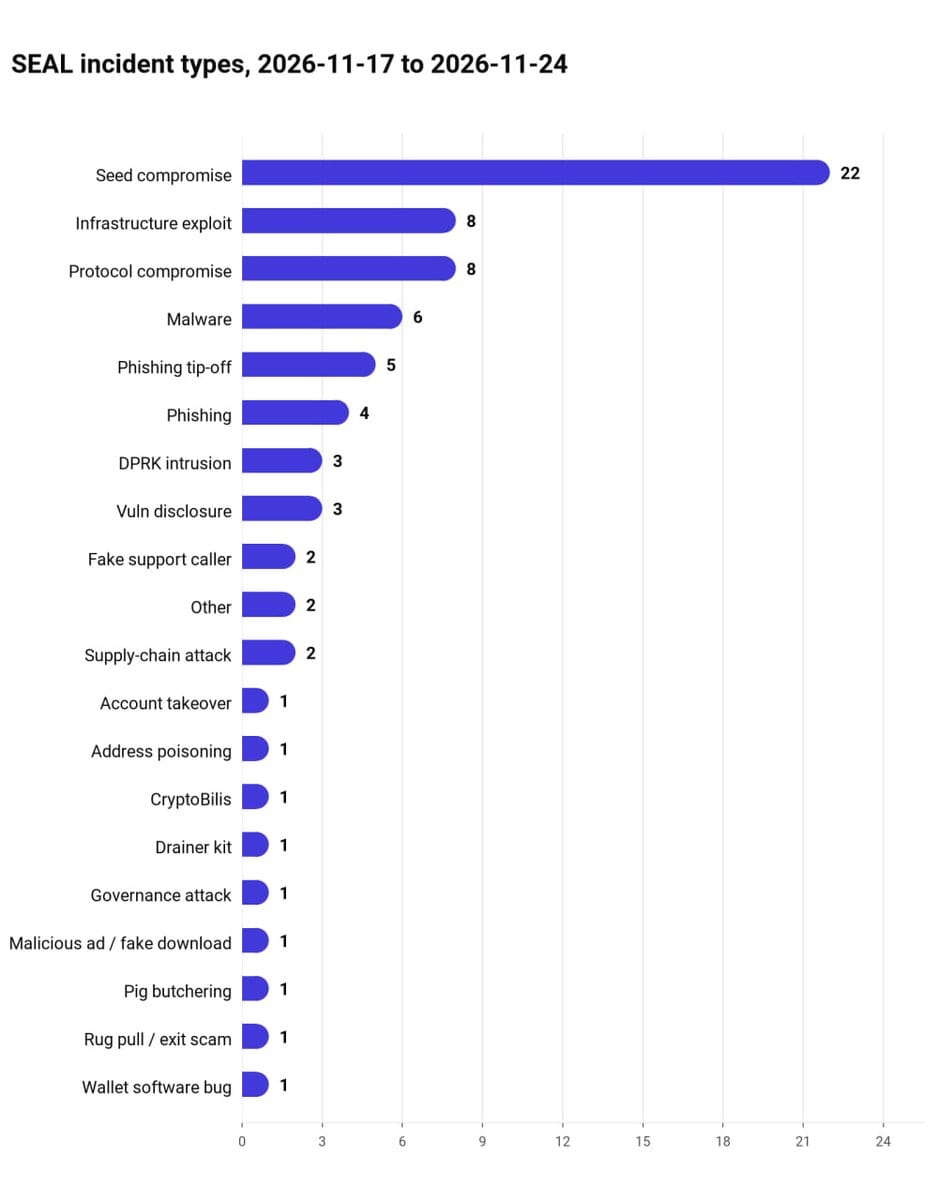
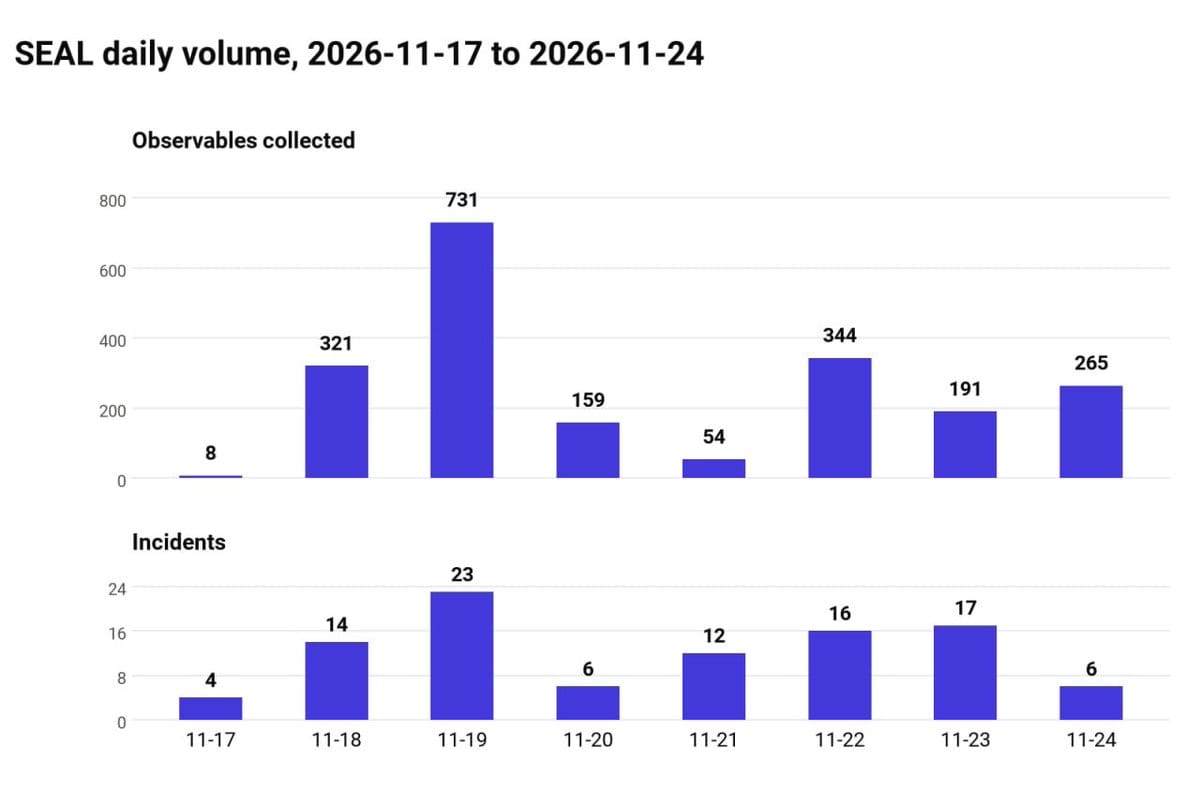
Our team triaged 76 incident reports over the last week. Here are the losses by category:
1) Protocol compromise: $17.55M
2) Infrastructure exploit: $5.6M + 770.5 ETH + 6.96 BTC
3) Seed compromise: $2.96M + 4.34 ETH + 3.08 BNB
4) Supply-chain attack: $588K
5) Malware: $312K
6) Fake support caller: $195K
7) Drainer kit: $130K
8) Phishing: $106K
9) CryptoBilis: $100K
10) Wallet software bug: 31.1 BTC
11) Fake app: $20K
12) DPRK intrusion: $16K
13) Other: $14K (more details below)
14) Rug pull: $8.6K
15) Address poisoning: $5K
16) Pig butchering: $2K
17) Governance attack: 0.105 ETH
No loss: 1 account takeover, 3 disclosures, and 5 tips.
What we collected
· 1,835 phishing domains
· 1,793 indicators published
· 129 wallets
Protocol Compromise
8 reports: $17.55M reported losses
- The largest: a cross-chain protocol had its vaults swept, ~$11.95M.
- A $3.43M vault was emptied with a flash-loan deposit-and-withdraw loop.
- A bridge lost ~$1.1M: the attacker registered their own signing key, withdrew the vault and minted 22M tokens.
- An off-ramp lost $153K from 87 customer wallets through forged orders on a legacy contract.
Infrastructure Exploit
8 reports: $5.6M + 770.5 ETH + 6.96 BTC.
- A smart-wallet service lost ~$2M: about 90 user wallets were emptied through the service's own relayer, with valid owner signatures.
- A second company lost ~$1.9M to an infrastructure breach.
- A provider of MPC wallet infrastructure reported client wallets drained: at least $580K + 510 ETH + 7 BTC.
Stolen keys leading to protocols/infrastructure exploitation:
- ~$1M: two admin keys. The attacker upgraded the lending-market tokens.
- ~260 ETH: a deployer key minted new supply on a second chain. The minter role was never renounced.
- $115K: the only owner key of a 1/1 multisig, held by an outside developer.
🚨 A key a contractor created is a key the contractor still has. At handover, rotate owners to keys you generated. Renounce roles nobody needs & never leave a mint or upgrade path behind one key.
No loss breach:
- An accounting platform was breached and its customers' exchange API keys were exposed. The keys were read-only.
Seed compromise
22 reports: $2.96M + 4.34 ETH + 3.08 BNB (1 wallet accounts for $2.3M)
Most victims don't know how the key left their device. After the initial exfiltration, many user funds are still locked in staking or a presale with a sweeper bot waiting on the wallet. In such case, contact FlashBots for rescue services.
Tampered hardware wallets
3 reports: $688K
Ledger devices that passed the genuine check & were drained while idle. One was bought sealed in a store. They're still being found, and not from the same actor. One device came from an unrelated marketplace seller in 2024.
🚨 Buy hardware wallets direct from the manufacturer.
Malware
9 reports: $328K
The largest, ~$298K: malware from a ClickFix page replaced the Ledger desktop app with a fake one. Funds left about a month later.
🚨 No website needs you to paste a terminal command.
DPRK intrusion
This week we observed a decrease in DPRK's fake Zoom/Teams campaigns conducted primarily by SINT-69 and UNC1069 clusters after FBI's recent disruption campaign (FaceStealer).
SINT-69 (DPRK): hijacked Telegram accounts & fake meetings. New:
- lives05[.]us[.]com
- us06meet[.]com
- vinmifam[.]com
- net05[.]us
UNC1069:
- tearnslive[.]co
Fake meeting calls aren't only DPRK. A developer ran a "meeting app" from a non-DPRK fake interview in 2024 & then reinstalled macOS. In October the old Mac went online again and a wallet whose seed sat in iCloud Notes was drained.
Malware-as-a-service fake Zoom page delivering macOS (cloudsyncd) and Windows loaders:
buzzmp[.]com
cdnportalwin[.]com
icafebolger[.]com
macos[.]eu05web[.]com
Fake meeting pages, unattributed, 18 new:
- microsft-teans[.]com
- micrsoft-teans[.]com
- microsoft-tems[.]com
- micosoftmeeting[.]online
- microsoftonline-ms[.]com
- teams-meetings[.]team
- joinmeetiing[.]live
- callconnect[.]cloud
- telcom[.]stream
- us12zoom[.]us through us18zoom[.]us
Contagious Interview
3 reports: ~$16K
We observed different types of Contagious Interview campaigns, sharing the same general TTPs but utilizing distinct tooling and infrastructure.
Others
- Electrum fee bump bug: 31 BTC lost in one payment. The victim pasted the right address and the coins went to another, through the Electrum fee-bump bug used by a malicious server. Not the first report of it we have had.
- Fake gift-card store: 2 victims, ~$164K. Both searched for Bitrefill and landed on a lookalike. One was a Vanilla Drainer page, $130K.
com-gift-cards-sei[.]com - Phishing overall: 4 reports, $106K. Type the address or use a bookmark. A search result is not the site.
- Fake support callers: 2 reports, ~$195K. Callers posed as Google and exchange support. One victim was sent to fake hardware-wallet sites and typed the recovery phrase. The other was walked through creating a "new wallet" the caller already controlled.
🚨 Support doesn't call you. 🚨 - Address poisoning, $5K: an address copied from wallet history was the attacker's lookalike.
- Fake app, $20K: a fake wallet app in an official app store.
- Rug pull, $8.6K: a honeypot token that cannot be sold.
- iOS wallet compromise: 4 of those reports, ~$342k (last week 9, ~$184k + 18 ETH). Trust Wallet and Tonkeeper on iPhone. Suspected DarkSword/Coruna exploit-kit victims.
🚨Update iOS. Move funds off any seed that lived on an unpatched phone.
Crypto drainers based on EIP-7702 sweeps. Several victims signed a "wallet upgrade" on a phishing page. The wallet now delegates to the attacker's contract and forwards anything that arrives, including gas sent to rescue it.
Our incident response service is free to anyone who needs it, and stays that way because people from the community fund it.If this week's numbers are useful to you, fund the next one: https://securityalliance.org/donate
If you require a direct data feed from SEAL-ISAC, contact us at [email protected].